By Gary Frueholz, Engel & Voelkers Real Estate
Alhambra draws much of its history and personality from having a railroad previously running through it. Prior to being placed into the “trench” along Mission Road in the 1970’s, the Southern Pacific railroad line ran at grade next to Mission and served one of the largest petro chemical equipment manufacturers in the world, the C. F. Braun Corporation at Fremont Avenue and Mission Road. The Alhambra Foundry further west on Mission had rail sidings leading into it, where it poured molten metal into items such as manhole covers that can now be seen throughout all of California. This railroad created an industrial hub in the southwest section of Alhambra that was pivotal in establishing jobs and tax revenue for our city.
The rail line in Alhambra was the second transcontinental route ever completed in the United States. It ran from Los Angeles to Texas and then to New Orleans in Louisiana and was completed on January 12, 1883, with its golden spike being driven in at Langtry, Texas. The route was completed by the “Big Four”, (Leland Stanford, Collis P. Huntington, Mark Hopkins, and Charles Crocker), who constructed the initial transcontinental route in the central part of the United States in 1869. Later, this route became known as the Sunset Route, in honor of the crack Southern Pacific passenger train, the Sunset Limited. During this time, prominent passenger trains would often have their own magazines, with the Sunset Limited’s magaine, Sunset Magazine, long outliving the train itself. The train itself was gorgeous, with passenger cars painted red, orange, and black to represent the colors of a sunset, creating an impressive atmosphere of a hotel on wheels.
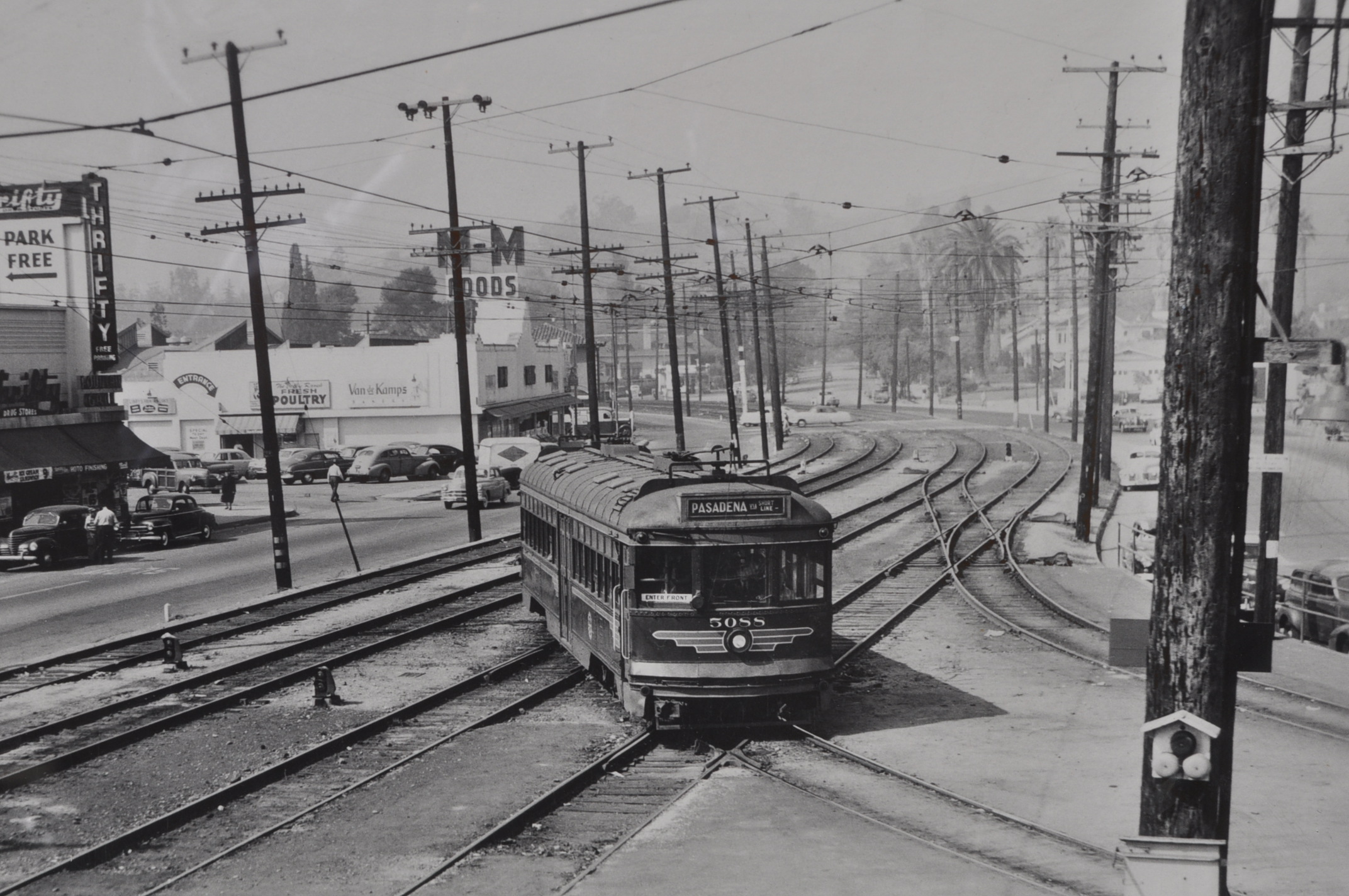
Southern Pacific’s railroad station at Mission Road and Palm Avenue was a popular destination and embarking site for passengers who sought to avoid the congestion of Los Angeles. These, however, were not the only railroad tracks running through Alhambra. Alhambra’s major streets such as Huntington Drive, Main Street, and Ramona Road had Pacific Electric Red Cars running along them, creating an extremely efficient means of mass transit for the city and attested to the strategic location of Alhambra.
Although these tracks, along with the Pacific Electric and Southern Pacific, are now long gone, evidence of the city’s railroad past is still with us, and the ghosts of Alhambra’s railroads can be seen to this day. Huntington Drive is a lovely, wide thoroughfare at Alhambra’s northern boundary with San Marino, thanks largely to its wide median, displaying lovely trees and green grass that have made it a favorite with joggers. Previously, that center median contained four Pacific Electric standard gauge tracks (four feet, eight and one half inches) which ran to downtown Los Angeles. Tracks from this line branched up Fair Oaks Avenue and Oak Knoll Avenue at junctions to Pasadena. The Oak Knoll Junction ran to the base of the mountains and connected to what was referred to as Southern California’s “Eighth Wonder of the World”, the Mount Low Railway. Stops were made at the cross streets of Marengo Avenue, Marguerita Avenue, Fletcher Avenue, Garfield Avenue, and Almansor Street. The Pacific Electric was the largest electric railway system in the world in the 1920’s and the brainchild of Henry Huntington, the nephew of Collis P. Huntington.

Today, the ghosts of Alhambra’s railroads can be seen at Story Park. Have you ever wondered why Story Park is neatly divided by Woodward Avenue into two sections that slope down to the Alhambra Wash? Where Woodward Avenue now resides, there once was a Southern Pacific Railroad trestle. The trestle was part of the Southern Pacific Duarte Branch line that served orange groves, Azusa gravel pits, and passengers. As the trestle grew older, the railroad filled in dirt below it to provide support as a cheaper alternative to rebuilding the bridge, although the remnants of the trestle can still be seen. On the dirt path from Woodward Avenue down to the tennis courts at Story Park there is a row of wood columns that belonged to the trestle and that are still visible. These ghosts of the old trestle are cut off and extend approximately twelve inches above ground.
More ghosts of Alhambra’s railroad history can be found near Alhambra Park. In the late 1800’s, Alhambra had an incredible winery, known as The San Gabriel Winery. This winery covered more than 800 acres between Alhambra Road and Mission Road and was considered the largest winery in the entirety of California. The winery also had a rail line that served it from the Southern Pacific line along Mission Road in Alhambra and from Pasadena. Rails from this line can still be seen poking through the asphalt at the intersection of Raymond Avenue and Vine Street.
Alhambra’s impressive past can be viewed through the ghosts of its railroad history. If you know where to look, you can still see some of these ghosts.
Gary Frueholz is a realtor with Engel & Volkers Real Estate, a past member of the Alhambra Planning Commission, a Certified Senior Real Estate Specialist, Certified International Property Specialist, and can be reached at 626-318-9436.